
Consultation and assessment
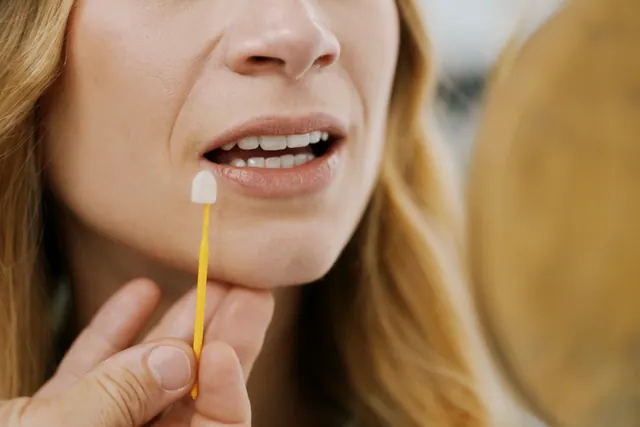
We check whether the treatment is right for you, and whether what you have in mind fits your budget. Photos, digital scan, examination. If another solution would suit you better, I’ll tell you at this stage.
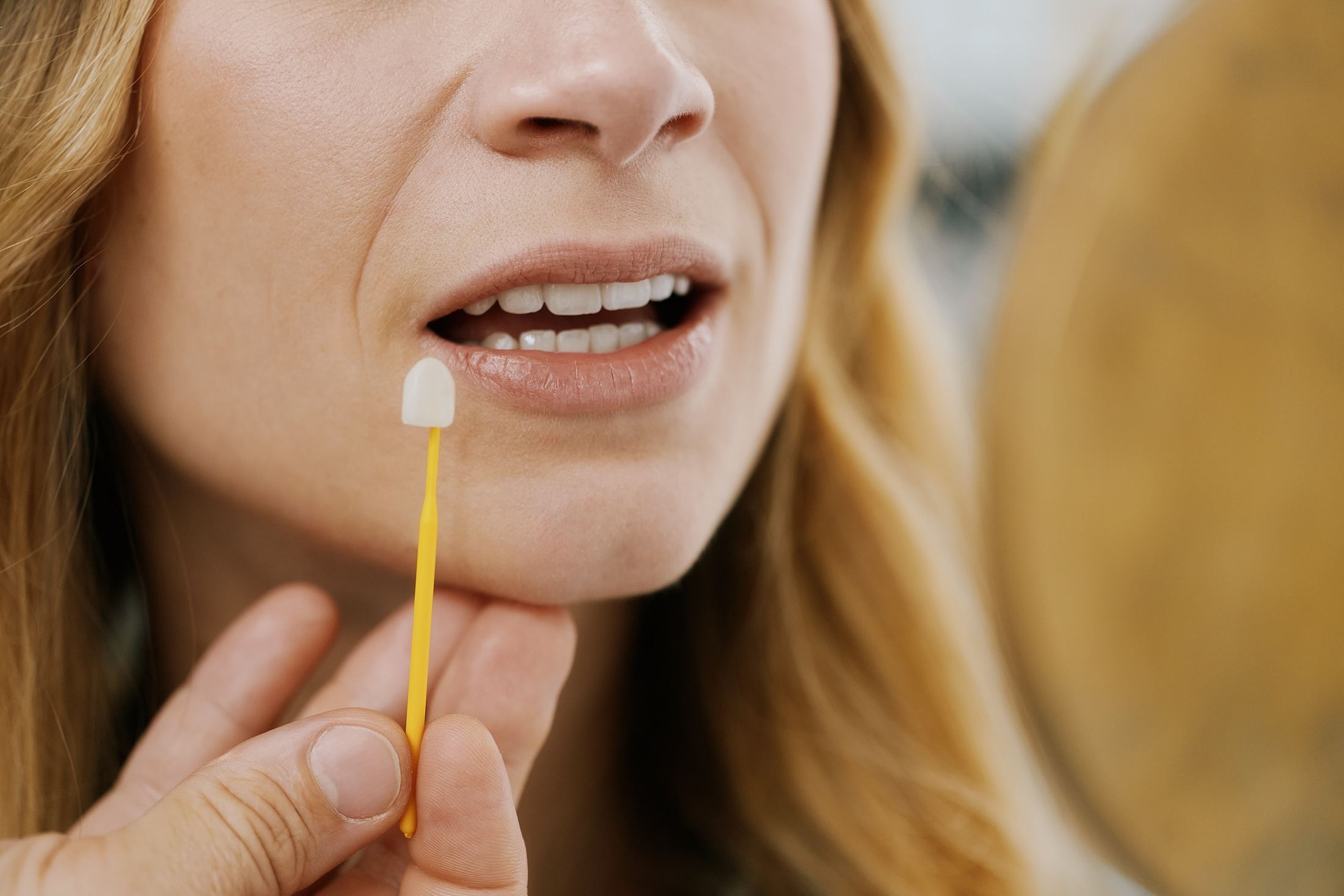
Veneers, also known as dental veneers, are wafer-thin shells bonded to the front of your teeth. They correct colour, shape and minor misalignment, and they’re the treatment the internet talks the most nonsense about.
This guide explains what veneers are from a medical point of view, which types there are, what they cost, how long they last and when I, as a dentist, advise against them. That last part is the one most websites leave out. It’s the most important.
A veneer is a thin facing made of ceramic or resin that covers the visible part of a tooth. It is between three tenths and about seven tenths of a millimetre thick: thinner than a contact lens, or roughly as thick as two sheets of paper.
Veneers don’t change the tooth itself. They sit over it like a façade and from then on decide what people see: colour, shape, surface, length, the position of the biting edge. What they can’t do is make an unhealthy tooth healthy. Under a veneer is the same tooth as before, and if it has decay, that has to be treated first.
The difference from a crown matters: a crown wraps all the way round the tooth and needs far more tooth structure removed to do so. A veneer only covers the front. That’s why it’s considered the more conservative option, provided the tooth underneath is strong enough.
Ceramic veneers are made from different ceramics depending on the case. Feldspathic ceramic is the most translucent and can be layered especially thin; it’s used where a natural look matters most. Lithium disilicate is stronger and is chosen when the shell has to withstand more, for example strong chewing forces. Composite veneers are made of the same tooth-coloured resin used for white fillings.
A veneer doesn’t stay on because it rests on the tooth, but because it’s bonded to it. The shell is adhesively bonded to the tooth, and that bond is much stronger on enamel than on the softer dentine beneath it. Which leads to a rule that says a lot about the quality of a treatment: the more enamel is left, the better the veneer holds.
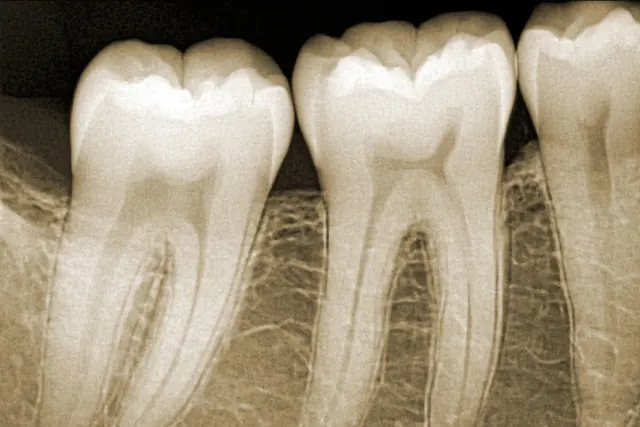
The enamel on the front of your front teeth is only a few tenths of a millimetre thick, and thinnest towards the gumline. Remove too much there and you end up in the dentine, losing exactly the surface the veneer is meant to hold on to. Minimal reduction is therefore not a marketing promise but a technical necessity.
They were invented in Hollywood: in the late 1920s, the dentist Charles Pincus stuck thin shells onto actors’ teeth for filming; they only lasted as long as the shoot. Veneers didn’t become durable until decades later, with adhesive bonding.
Ceramic
Composite
lithium disilicate, feldspathic ceramic
resin composite
0.3–1.0 mm
practically none
over 10 years
considerably shorter
best aesthetics, strong, doesn’t stain
affordable, done in one visit
irreversible
stains over time, less strong
We use two kinds. They differ in material, in thickness and in how much of the tooth has to be prepared beforehand.
The most common kind. The shell is made in the lab, and because ceramic refracts light much like natural enamel, the result is hard to tell apart from real teeth. Colour, shape and surface texture are matched individually. Ceramic suits more severe discolouration and larger changes in shape, and with good care it’s the longest-lasting option. In return, the tooth surface is minimally reduced first.
Tooth-coloured resin, shaped directly in the mouth, in one visit and usually without any reduction. Modern techniques don’t work freehand, but with a clear mould made from a digital model: the composite is injected rather than applied, which gives a more even result. Composite suits smaller corrections. Its biggest advantage isn’t the price, it’s that you can still change your mind.
Which kind is right for you isn’t decided by price but by the clinical findings: how much of the tooth is still original, and how big should the change be? We compare the materials in detail in the article Types of veneers compared.
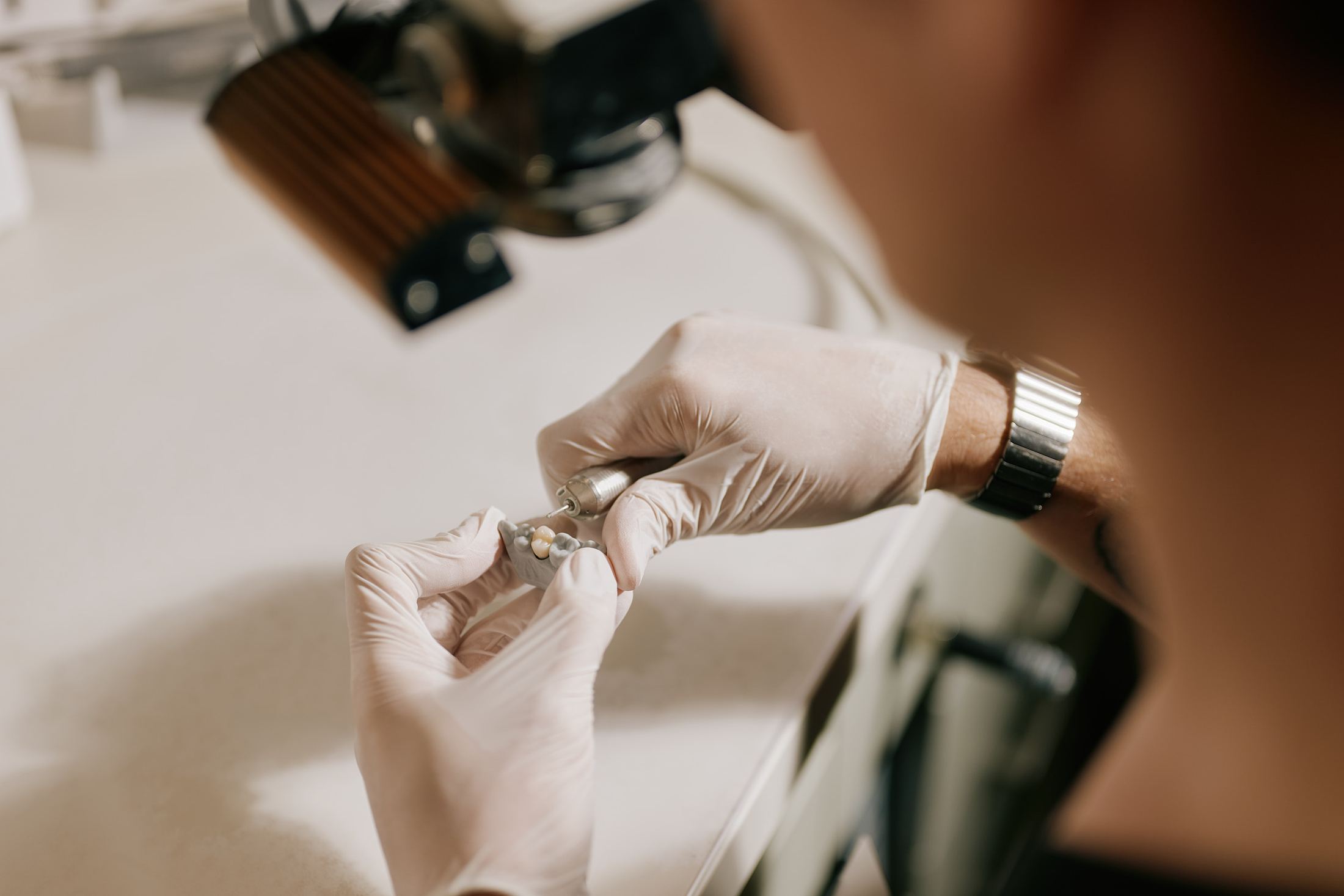
It’s the question I’m asked most often, and the answer depends on how the work is done. What matters is not whether, but how much.
The front of your incisors is covered in enamel, between about three tenths of a millimetre and one millimetre thick depending on where you measure. For a ceramic veneer, usually three to seven tenths of that are removed, roughly the thickness of an eggshell. This is irreversible: what’s removed doesn’t grow back.
The most important rule here: stay within the enamel. Beneath it lies dentine, and dentine behaves differently. The adhesive doesn’t bond as well, the tooth becomes more sensitive to cold, and the bond lasts less long.
Here there’s usually no reduction at all. The composite is built up on the tooth, not into it. That’s why the treatment can be removed again, leaving the tooth as it was before. The trade-off: composite doesn’t last as long and stains over the years. If you’re unsure, this is the route that keeps every door open.
The pictures you find online show something else: teeth ground down to stumps. Those aren’t veneer preparations, they’re crown preparations. Anyone who removes half your tooth for a veneer is really doing a crown and calling it something else. More on this in the article Do veneers damage your teeth?.
With a mock-up, the planned tooth shape is applied directly in your mouth, over teeth that haven’t been touched. You see and feel your result before anything is irreversible. You walk around with it and show it to people; you can’t eat with it, it’s too thin for that. That’s exactly its value: it’s the last point at which you can say no without it costing you anything.
Before that, we plan your new teeth digitally, based on a scan and your photos. That plan becomes the mock-up, and the mock-up becomes a silicone key that guides the preparation and shows how much may be removed.
This key is the whole difference between minimally invasive as a word and as a method. Without it, you’re estimating, and when in doubt, anyone estimating removes more. With it, exactly as much is removed as the planned shape needs. In some places, that’s nothing at all.
A mock-up with us costs from €450 per jaw. For a single tooth you usually don’t need one, but sometimes you do. It’s the item most often missing from cheap quotes, and the only one where I’d advise against cutting corners.
We check whether the treatment is right for you, and whether what you have in mind fits your budget. Photos, digital scan, examination. If another solution would suit you better, I’ll tell you at this stage.
The scan becomes a digital plan, and the plan becomes the mock-up. You try it on in your mouth and only decide after that. Without your yes, nothing goes any further.
The teeth are minimally prepared, guided by the silicone key from the mock-up. Then the veneers are made in our in-house dental lab: the ceramic is layered by hand and matched to your other teeth. In the meantime, you wear temporaries. They protect your teeth and show you how the new shape feels when you talk and eat. If anything strikes you, that’s the moment to say so: changing a temporary is easy, changing a finished veneer isn’t.
The veneers are bonded in place and given their final adjustments. If something isn’t right, there are further try-ins; that’s built into the plan. A week later, we check the fit, your bite and your gums.
Four steps, usually spread over five appointments. Worn teeth need two more.
With worn teeth, tooth structure has been ground away over the years, usually through grinding at night, and the bite has dropped. Then it’s not enough to rebuild the shape: the same force would go on to work against the new veneers. That’s why we first measure your jaw joint electronically: a bow resting on the bridge of your nose, a sensor on your teeth, 45 to 60 minutes, completely painless. The data is used to make a bite-raising splint that you wear for a while before anything is bonded. That turns five appointments into seven. More on this on our page about jaw joint problems and TMD.

With the mock-up, you wear your result in your mouth before a single tooth is prepared. If you don’t like it, nothing has happened. Come in for a first consultation. We’ll also tell you if another solution would suit you better.
Book a consultationWith good care, ceramic veneers last more than ten years. The most robust figures come from a long-term study at the Medical University of Innsbruck, which followed 318 veneers in 84 patients for up to 20 years:
The same study also shows why veneers fail: grinding at night and root-canal-treated teeth clearly increased the failure rate, and in smokers the margins discoloured more. That matches what we see in practice, and it’s why I tend to recommend a crown for root-canal-treated teeth and always add a splint for grinders.
What shortens their lifespan is well known: grinding without a splint, smoking, careless cleaning of the margins and heavy loads no tooth is made for. What extends it is unspectacular: good oral hygiene, regular check-ups and a bite that’s right.
A veneer also only lasts as long as the tooth underneath stays healthy. That’s why professional teeth cleaning is part of the treatment, not an optional extra.
If something does happen, the repair depends on the material. A chipped composite veneer can often be fixed directly in the mouth. With ceramic, a repair is usually only a temporary solution; as a rule, the shell is replaced.
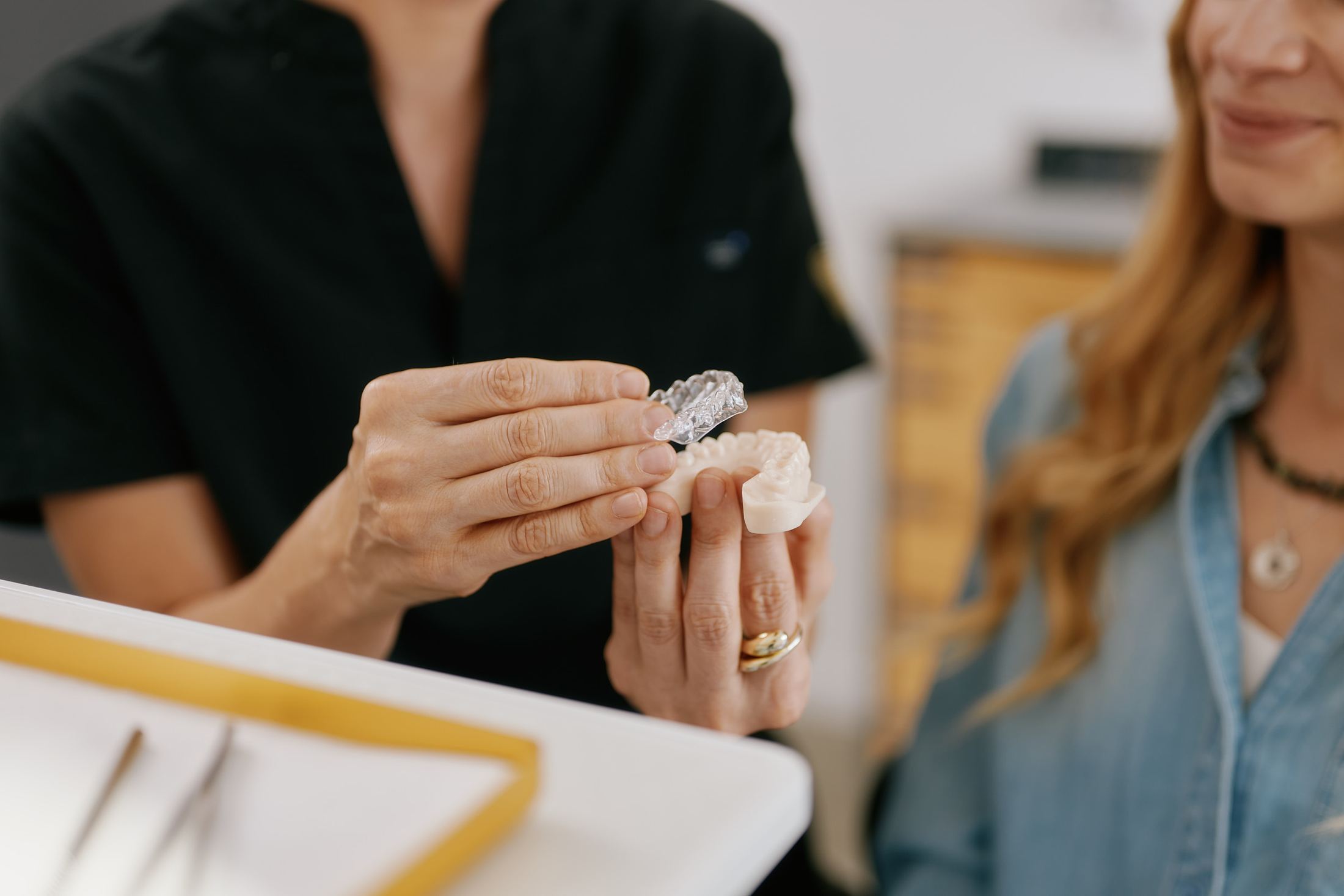
Four things need saying before we get to the six situations in which I advise against them.
If the only thing that bothers you is how your teeth are aligned. When patients talk only about alignment, not colour, not shape, and their teeth are free of fillings with lovely translucency, I recommend clear aligner treatment. It moves the teeth instead of covering healthy tooth structure, and it’s also cheaper.
If the teeth have had root canal treatment or have very large fillings. Then a crown is sometimes the better restoration, because it encloses the weakened tooth. The long-term data supports this: on non-vital teeth, veneers fail measurably more often.
If oral hygiene is persistently poor and that can’t be changed. Veneers need clean margins. Where they aren’t looked after, decay develops exactly where it’s hardest to treat.
If there is active, untreated periodontitis. Your gums have to be healthy first, otherwise the gumline shifts later and exposes the edge of the veneer. Periodontitis treatment comes first.
If you’re very young. 18 is the minimum age; before that, your teeth haven’t finished developing.
And if you can’t afford them. If you’d have to take on serious debt for veneers, you shouldn’t get them. That’s not a medical indication, just honest advice.
Veneers in Turkey or Hungary cost a fraction of the price. That’s not a rumour, it’s a fact, and there are understandable reasons for it: lower wages, rents and lab costs.
There are four things a price comparison doesn’t show. First, time: doing it properly takes several appointments over a number of weeks. Anyone who gets it done in five days skips the try-in or cuts intermediate steps. Second, aftercare: if an edge chips after six months, the practice is 2,500 kilometres away. Third, warranty: enforcing claims abroad is difficult in practice. And fourth, documentation: without it, a practice here can only guess what was done.
That doesn’t mean the work abroad is bad. It means the price isn’t the whole bill. And there’s one point that rarely gets mentioned: if you travel to save money, you usually can’t afford corrective work at German prices either. The saving is certain; the corrective work is a risk.
We’ve done the full maths in the article Veneers in Turkey: an honest comparison.
Veneers
Teeth whitening
Composite
Clear aligners
changing shape, colour and length
healthy but discoloured teeth
a small chip or corner
crooked or rotated teeth
0.3–1.0 mm
practically none
practically none
none
usually
Veneers are rarely the only solution, and often not the most obvious one.
Often the best answer is a combination: whiten first, wait two weeks, then put veneers only on the two teeth that really need them. That costs a fraction and preserves your natural tooth structure.
As a rule of thumb: if only the colour bothers you, think teeth whitening first. If only the alignment bothers you, think clear aligners first. If both bother you, or shape and surface come into it too, veneers are usually the route with the best balance of effort and result. And if nothing really bothers you, and it’s just an image you can’t get out of your head: wait a little longer.
The consultation fee is credited towards the treatment if you decide to go ahead.
Veneers are a purely cosmetic treatment. Statutory health insurance doesn’t cover them. Some private supplementary insurance policies pay a share; check this beforehand, and get it in writing.
What mainly determines the price is the number of veneers. If you’re correcting two front teeth, you’ll pay a fraction of what a treatment of the upper and lower jaw costs. Larger amounts can be paid in instalments through our partner Mediserv Bank, subject to a credit check: six instalments interest-free, terms of up to 56 months.
Not included are treatments that may be added depending on your case: professional teeth cleaning before the treatment, a night guard if you grind your teeth at night, or treating decay and gum problems beforehand. These aren’t hidden costs; they’re in the cost estimate before you commit. You’ll find a detailed breakdown in the article How much do veneers cost?.
A calculation hardly anyone does, and the one that tells you the most: spread the €1,500 starting price over ten years and it comes to €150 a year, and the Innsbruck figures above suggest many last longer. Composite costs a good third of that, but needs replacing much sooner. Over five years, composite is the cheaper choice; over twenty, it’s almost always ceramic.



I’ve been grinding my teeth since I was 16, a lot of my front teeth were damaged, and I didn’t like looking in the mirror. Hannes didn’t try to sell me anything: he took his time looking at my teeth, scanned them, and I got to test-drive the temporaries. Six months on, the veneers feel like my own teeth. By far the best dentist I could find in Berlin.
I wanted teeth that reflect the car headlights when I’m out on my bike. Hannes only shaped them very slightly, no anaesthetic, and I didn’t feel a thing. To me he’s not a dentist, he’s an artist: a sculptor, Da Vinci, Picasso. Before and after, I’m a completely different person. My teeth shine like the sun.
I didn’t want fake-looking teeth, I wanted the result to look natural. The whole process was easy to follow, and we talked openly beforehand about the fact that it would hurt, too. My daughter says: wow, cool. My girlfriend says: you use your face differently now, more openly. It was a huge weight off my shoulders. I’d encourage anyone who’s unhappy with their teeth.
Short answers to the things we're asked most often. If your question isn't here, just get in touch.
Send us a photo of your teeth. We’ll get back to you with a first assessment and a cost range.