Skip to content
Call us

Dental prosthetics in Berlin: made in our own practice lab

Made where you’re treated

Our crowns, dental bridges and dentures are made in our own in-house dental lab, a few metres from your treatment chair. If something doesn’t fit, it doesn’t go in the post, it goes through a door. That saves weeks and spares you appointments.

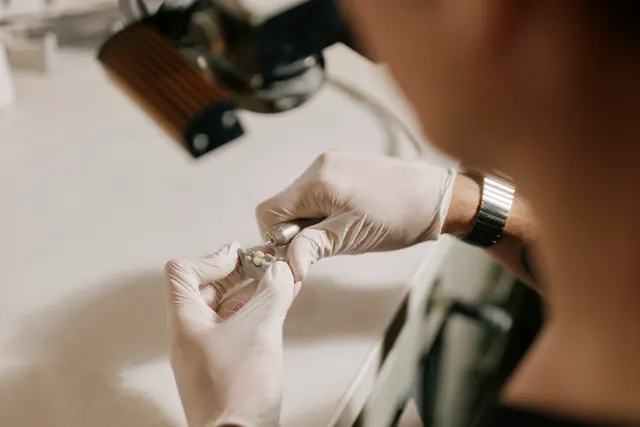
Gloved hands grinding a small crown in the in-house lab
The question first, then the solution

When do you need a crown, bridge or denture?

A tooth can’t be saved any more, an old crown won’t hold, or several teeth are missing at once.

Dental prosthetics close the gap, and do more than just fill it: they keep the neighbouring teeth in place, spread the chewing forces and help your face keep its shape. Which solution suits you depends on how many teeth are missing and what the bone underneath can still support.

Eight ways, one goal

Crowns, bridges, dentures: which solution fits?

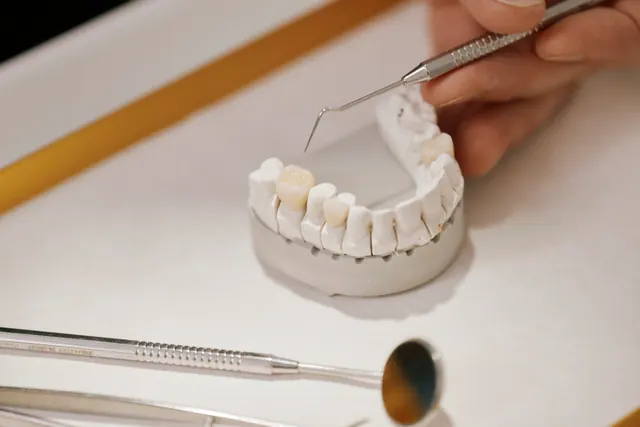
A crown on a plaster model

Inlays and partial crowns replace part of a tooth: what a filling can no longer hold, a piece made in the lab takes over. A crown covers the whole visible part when too little of the tooth is left, veneers cover only the front. If a tooth is missing entirely, a bridge resting on the neighbouring teeth is an option, or an implant, which manages without them. For the months while an implant heals, there are long-term temporaries. If a whole row of teeth is missing, a fixed bridge replaces all the teeth of one jaw. It sits on four to six implants: from four in the lower jaw, from six in the upper jaw. More on that on the page about All-on-4.
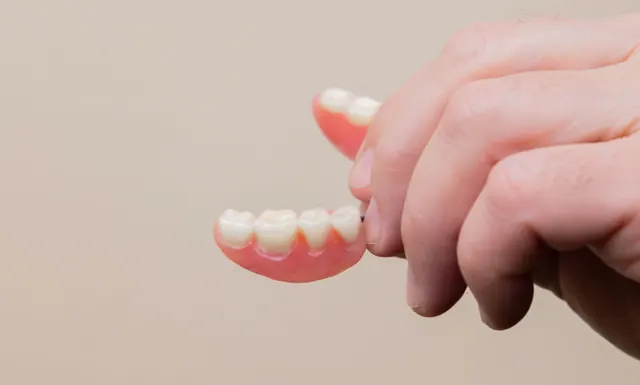
A partial denture held in a hand

Partial dentures replace individual teeth and hold on to your own, full dentures replace a whole jaw. In between are telescopic and bar-retained dentures: they sit on prepared natural teeth or on implants and can still be taken out for cleaning. Telescopic restorations sit more firmly than many people expect: the hold comes from the abutments, not from the palate.

Our reputation precedes us

Our own practice lab: why it makes the difference

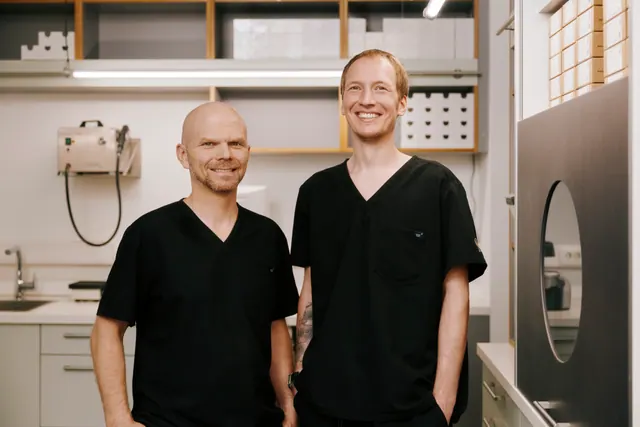
Our in-house lab is run by a master: master dental technician Sebastian Krzizek and dental technician Alexander make crowns, bridges and implant prosthetics all the way to All-on-4, digitally on CAD/CAM and layered by hand. Neither of them sees your teeth only as a scan: colour, shape and bite are adjusted in person, instead of being described back and forth by post. If something doesn’t sit right when it’s fitted, there’s only a door between the chair and the workbench.

Two to five appointments

How does the treatment work?

1

Diagnosis and plan

We check what can still bear the load and talk through the options, including costs. From that comes the treatment and cost plan you submit to your health insurer. It lists the standard treatment, your fixed subsidy and your own share. How high the subsidy is also depends on your bonus booklet.

2

Digital impressions

We scan instead of taking moulds. The scan goes straight to the lab next door, nothing goes in the post.

3

Made in-house

Our dental technicians make your crown, bridge or denture. For crowns, bridges and implant crowns, that usually means two appointments; for dentures and telescopic restorations, four to five. This is where you first notice the lab is in-house: a try-in or a correction costs an appointment, not a week of shipping.

4

Fitting and fine-tuning

We fit it, check your bite and adjust until nothing presses any more. Short distances mean that adjustments don’t cost you a week.

What do crowns, bridges and dentures cost?

Ceramic inlay, one surface

from €950

Crown

from €1,200

Partial crown

from €1,300

Implant-supported crown

from €1,400

Bridge with two abutments

from €2,000

Telescopic crown on a natural tooth

from €1,500 / telescope

Telescopic crown on an implant

from €1,800 / telescope

Complete denture, one jaw

from €600

Complete dentures, both jaws

from €1,200

Long-term temporary (Clearsplint)

from €500

Statutory health insurers pay a fixed subsidy towards the standard treatment, that is, the solution considered necessary for your findings. If you choose something else, the subsidy stays the same and the difference goes on your bill. That’s why what you pay in the end is in the treatment and cost plan before treatment, not afterwards. Subject to a credit check, you can pay in instalments through our partner Mediserv Bank: six instalments interest-free, terms of up to 56 months.

Hallway with framed pictures and a bench
Say ah, we’re all ears

Advice comes first

We start by listening: how can we help, what’s bothering you, what would you like? Then we look for the right solutions together and agree on materials and costs with you. In the end, there should be only one reason for your jaw to drop: your healthy, radiant smile.

Hannes Schulte-Ostermann with the dental technician in the in-house lab
Precision, not copies

Our in-house lab

Everything we make is made under the same roof. Short distances mean less waiting and the chance to make adjustments straight away.

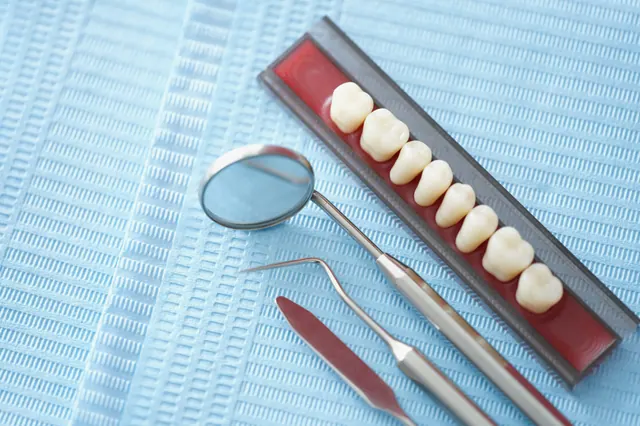
A row of replacement teeth next to instruments
No half measures

Making your new teeth last

Good dental prosthetics last for many years if the foundation is right. What matters most is the margin: where crown and tooth meet, decay sets in as soon as plaque is left there. Some people need periodontitis treatment before their prosthetics, so that the bone that will later hold the abutments can bear the load.

FAQ

Frequently asked questions about dental prosthetics

Short answers to the things we're asked most often. If your question isn't here, just get in touch.

Many years, with good care. What matters is less the material than the tooth underneath and how cleanly the margin fits.

A fixed subsidy towards the standard treatment, at least 60 percent. With a complete dental bonus booklet (Bonusheft), up to 65 percent, and after ten years up to 75. Anything beyond that, you pay yourself.

Often, yes. A chipped porcelain facing or a loose crown can usually be fixed, and because the lab is in-house, it’s quicker than sending it away.

As long as there’s enough of your own tooth left, a crown is the most conservative solution. If a tooth is missing entirely, an implant leaves the neighbouring teeth untouched; a bridge needs them as abutments.

For crowns, bridges and implant crowns, usually two appointments. Dentures and telescopic restorations take four to five.

Contact

You probably already have a cost estimate in your pocket. Bring it along, and your bonus booklet too. We’ll tell you what’s in the quote, what of it is necessary, what it costs with us and what we would do differently.

Get advice now (opens in a new tab)